Hair loss is one of the most common concerns people face today, and the good news is, it's treatable. If you're considering a hair transplant in Islamabad, you've probably come across two popular techniques: FUE vs DHI Hair Transplant in Islamabad. Both deliver natural-looking results, but they work differently and suit different hair loss patterns.
So which one is right for you? This guide breaks down the key differences, costs, results, and who each technique is best suited for, helping you make a confident, informed decision in 2026.
What is the Difference Between FUE and DHI Hair Transplants?
It is common for patients to feel uncertain about whether to choose FUE or DHI for their procedure. In reality, the difference between FUE and DHI hair transplant is not about one being universally better; it's about which one suits your specific hair loss pattern and goals.
What is a FUE Hair Transplant?
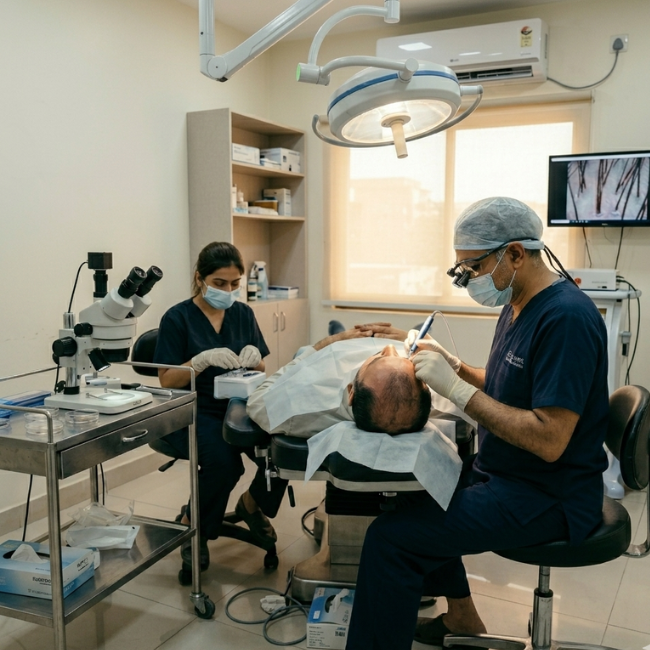
FUE (Follicular Unit Extraction) is the most widely performed hair transplant technique in the world. In this process, individual hair follicles are extracted one by one from the donor area (usually the back of the head) using a tiny punch tool. These follicles are then manually placed into small channels created in the balding area.
FUE leaves no visible linear scar. Recovery is relatively quick, and the results look natural. It's a proven, flexible method that works well for a wide range of hair loss stages.
What is a DHI Hair Transplant?
DHI (Direct Hair Implantation) is a refined version of FUE. The key difference is in the implantation step. Instead of creating channels first and then placing follicles separately, DHI uses a specialized tool called the Choi Implanter Pen. This pen extracts, loads, and implants each follicle in one precise motion, simultaneously creating the channel and placing the graft.
This gives the surgeon more control over the angle, direction, and depth of each hair, which is especially useful when designing a natural-looking hairline.
FUE vs DHI: Key Differences at a Glance
|
Feature |
FUE (Follicular Unit Extraction) |
DHI (Direct Hair Implantation) |
|
Implantation Tool |
Forceps (Manual placement) |
Choi Implant Pen (Precision tool) |
|
Channel Creation |
Separate step before implantation |
Done simultaneously during implantation |
|
Best For |
Extensive coverage & maximum grafts |
Hairline design & high-density zones |
|
Graft Survival Rate |
High (~90–95%) |
Maximum (~95–98%) |
|
Session Duration |
Shorter (4–6 hours) |
Longer (6–8+ hours) |
|
Recovery Time |
Fast (7–10 days) |
Slightly faster due to less trauma |
|
Cost |
More budget-friendly |
Premium pricing |
How Does Each Technique Work?
Understanding how each procedure works can help you feel more confident and prepared before making your decision.
FUE Hair Transplant
Here's a simple step-by-step breakdown of how FUE works from start to finish.
-
The donor area is shaved and numbed with local anesthesia.
-
Hair follicles are extracted one by one using a small circular punch.
-
Tiny channels are made in the recipient (balding) area.
-
Grafts are placed into these channels using forceps.
-
The scalp is cleaned and bandaged.
DHI Hair Transplant
DHI follows a similar path, but with one important difference: the implantation is more precise and controlled. Here's how it works.
-
The donor area is prepared similarly to FUE.
-
Follicles are extracted one by one.
-
Each follicle is loaded into the Choi Implanter Pen.
-
The pen simultaneously creates a micro-channel and deposits the graft.
-
No pre-made incisions are needed in the recipient area.
The DHI process takes longer per graft but offers finer control, especially along the hairline.
FUE vs DHI Which Gives Better Results?
Both FUE and DHI are proven techniques, but the right choice depends on your specific hair loss pattern and goals. Let's break it down.
Density and Hairline Restoration
FUE typically covers up to 65 grafts per cm², which is very effective for larger areas. For broad coverage across the scalp, FUE is usually the more practical and efficient choice. DHI, on the other hand, allows up to 80 grafts per cm² in targeted zones, making it excellent for dense hairline work.
Graft Survival Rate
FUE delivers excellent survival rates of around 90–95% when performed by a skilled surgeon. DHI minimizes the time follicles spend outside the body, which is why graft survival rates are often slightly higher, cited at 95–98%.
Natural-Looking Results
Both techniques produce natural results. The key factor isn't the tool, it's the surgeon's skill, experience, and artistry. A well-executed FUE can look just as natural as DHI, and vice versa.
Now that you understand how both techniques work, the next step is identifying which option suits your needs.
FUE or DHI Which One is Right for You?
Ideal Candidates for FUE Hair Transplant
-
Men with moderate to advanced hair loss (Norwood Stage 3–6)
-
Those who need broad coverage of the crown or mid-scalp
-
Patients looking for a cost-effective, proven solution
-
Anyone needing a larger number of grafts in one session
FUE is also considered the best FUE hair transplant in Pakistan option for patients who want maximum coverage without a high cost.
Ideal Candidates for DHI Hair Transplant
-
Men in the early stages of hair loss (Norwood Stage 2–3)
-
Patients focused on hairline detail and temple precision
-
Those who want high-density results in a specific zone
-
People who prefer minimal scalp trauma and faster healing
FUE & DHI Hair Transplant Cost in Islamabad
One of the most important factors when choosing between FUE and DHI is the cost, and it varies depending on the technique, number of grafts, and the clinic you choose.
FUE Hair Transplant Cost in Islamabad
At Dr. Hijrat Clinic, FUE hair transplant in Islamabad starts from PKR 70,000 and can go up to PKR 250,000, depending on the number of grafts required and the extent of hair loss. This makes it one of the most affordable yet quality-assured options in the capital.
DHI Hair Transplant Cost in Islamabad
DHI hair transplant cost in Islamabad is generally 10–20% higher than FUE due to the specialized tools and extended procedure time. Across Pakistan, DHI hair transplant costs typically range from PKR 150,000 to PKR 300,000, depending on the clinic, surgeon experience, and graft count.
Factors That Affect the Cost
-
Number of grafts needed
-
Technique chosen (FUE or DHI)
-
Surgeon's experience and credentials
-
Clinic facilities and aftercare packages
-
Location within the city
We highly recommend requesting a detailed, written price breakdown before you finalize your decision with any clinic.
Hairline Restoration Techniques: Which is Best in 2026?
In 2026, the most effective hairline restoration techniques remain FUE and DHI often used together. DHI is particularly favored for hairline precision because of the Choi Pen's ability to control angle and depth. Sapphire FUE (using sapphire-tipped blades for channel creation) is also gaining popularity for its faster healing and cleaner incisions.
The best approach depends on your case. A proper in-person consultation with a qualified surgeon is the only way to know which technique or combination is right for you.
How to Choose the Right Hair Transplant Clinic in Islamabad
Choosing the right clinic matters as much as choosing the right technique. Look for a board-certified surgeon, transparent pricing, real patient results, and proper aftercare support.
At Dr. Hijrat Clinic in Islamabad, you get honest assessments and customized treatment plans focused on natural, long-lasting results.
Conclusion
Choosing between FUE and DHI doesn't have to be overwhelming. FUE is ideal for larger coverage areas and is more cost-effective. DHI offers superior precision for hairline work and dense zones. In many cases, a combination of both gives the best outcome.
What truly matters is having a skilled, experienced surgeon guide your decision based on your specific hair loss pattern, donor quality, and long-term goals.
If you're ready to take the next step, book a free consultation at Dr. Hijrat Clinic today. Get a personalized assessment and find out which technique is right for you with no pressure, just honest guidance.
Frequently Asked Questions (FAQs)
1. Is FUE hair transplant the best option in 2026?
It remains the most reliable and popular choice for broad coverage. However, the best way depends entirely on your specific hair loss stage.
2. Which is better for the hairline?
DHI is often preferred for the hairline because it allows for better control over the direction of hair growth, though a skilled surgeon can achieve great results with either..
3. What is the DHI hair transplant cost in Pakistan?
DHI hair transplant cost in Pakistan typically ranges from PKR 150,000 to PKR 300,000, depending on the number of grafts, surgeon expertise, and clinic. Always request a detailed quote based on your specific case.
4. How long does it take to see results after a hair transplant?
New hair growth usually begins around month 3–4. Noticeable density appears by month 6–9, and full results are typically visible between 12–18 months after the procedure.
5. Is a hair transplant painful?
No. Since local anesthesia is used for both FUE and DHI, you won't feel pain during the surgery. Any mild soreness afterward is easily managed with standard medication.