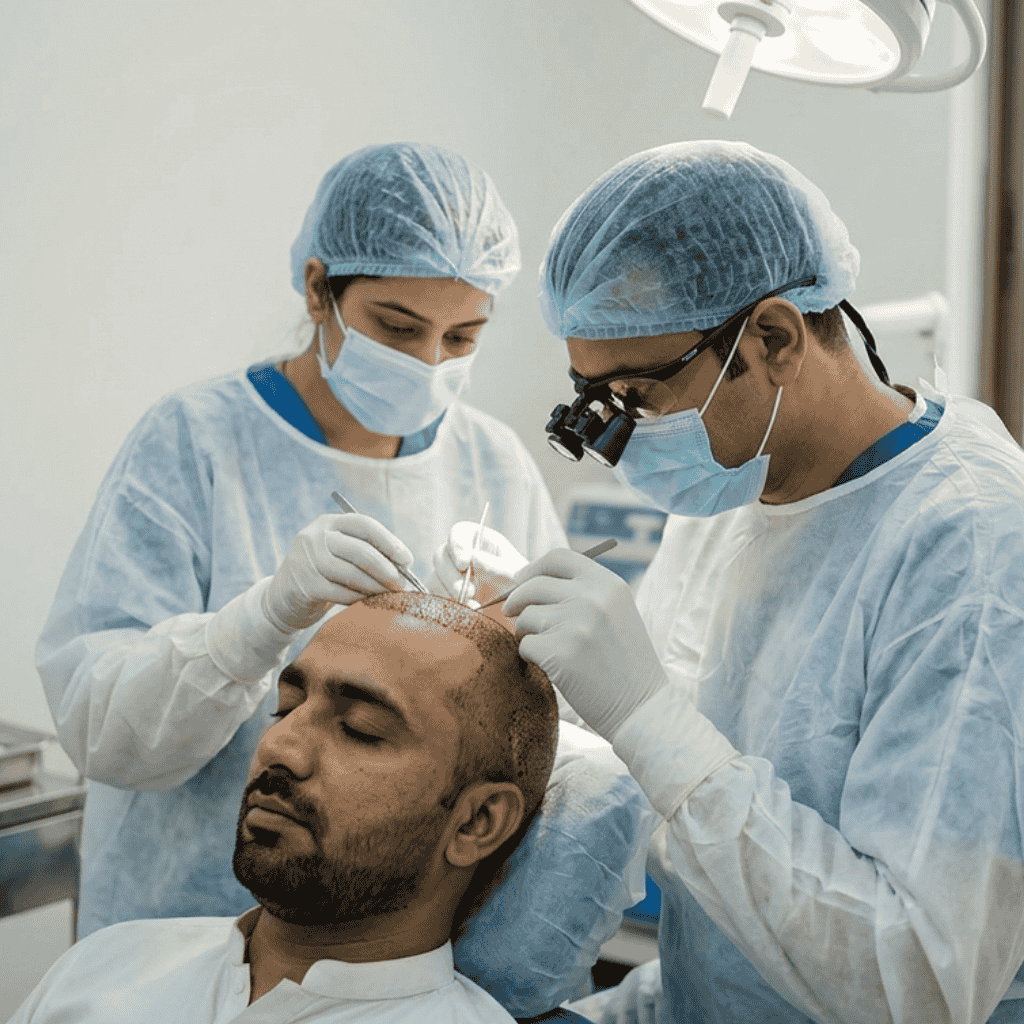
Are you struggling with hair loss and searching for a permanent, natural-looking solution in Islamabad? You are not alone. Hair loss affects millions of men and women across Pakistan. The good news is that a hair transplant in Islamabad has become one of the most reliable and permanent ways to restore your natural hair, and the results provide a completely natural look.
At Dr. Hijrat Clinic, we have helped hundreds of patients from across Pakistan, including Rawalpindi, Peshawar, and Lahore, regain their confidence. We also proudly serve many overseas clients who trust us for their hair restoration. Whether you are just starting to research your options or are ready to book your consultation, this complete guide covers everything you need to know about techniques, costs, and recovery to help you find the best hair transplant surgeon in Pakistan.
What Is a Hair Transplant?
A hair transplant is a surgical procedure that moves healthy hair follicles from dense areas of the scalp to thinning regions. This permanent solution restores your natural hairline by transplanting hair that is resistant to future balding.
How Does It Work?
The hair transplant process follows a simple, three-step journey to move your own healthy hair to thinning areas.
1. The Extraction Phase
We begin by carefully harvesting individual hair follicles from your donor area at the back of your head, where hair is naturally programmed to grow for a lifetime.
2. The Implantation Phase
Our team creates microscopic incisions in the thinning areas, precisely angling them to match your natural hair growth. This ensures your final result looks seamless, authentic, and completely natural.
3. Growth and Recovery
Once placed, the follicles gradually establish a new blood supply and begin growing naturally. The entire procedure is performed under local anesthesia, ensuring you stay comfortable and pain-free throughout.
Understanding Hair Loss:
Before undergoing a hair transplant in Islamabad, it is essential to understand the degree of your hair loss. Surgeons worldwide use the Norwood Scale to categorize the stages of male pattern baldness:
-
Stage 1: No significant hair loss or hairline recession.
-
Stage 2: Minor recession around the temples.
-
Stage 3: The earliest stage of clinically significant baldness; a deep recession at the temples.
-
Stage 4: Recession at the hairline and a bald spot at the vertex (crown).
-
Stage 5-6: The bridge between the two balding areas begins to disappear or thin significantly.
-
Stage 7: The most advanced stage of hair loss, where only a band of hair remains at the back and sides.
Identifying your stage helps the best hair transplant surgeon in Pakistan determine how many grafts are needed to achieve your desired density.
Modern Hair Transplant Techniques
Hair restoration technology in 2026 has advanced significantly, offering more precise and natural results than ever before. We offer the three most advanced and proven techniques currently available in Pakistan. Choosing the right technique depends on your individual needs and hair loss pattern.
1. FUE Hair Transplant in Islamabad
Follicular Unit Extraction (FUE) is the most widely performed technique today. In this method, individual hair follicles are extracted one by one using a precision micro-punch tool.
-
No Linear Scarring: Because there is no large incision, the procedure leaves only tiny, dot-like marks that are virtually undetectable.
-
Quick Recovery: Most patients return to their normal routine within 5 to 7 days.
-
Versatility: FUE is ideal for those who prefer short hair.
2. FUT Hair Transplant
Follicular Unit Transplantation (FUT), also known as the Strip Method, involves removing a thin strip of scalp from the donor area.
-
Maximum Grafts: This technique allows for a larger number of grafts to be harvested in a single session, making it effective for advanced baldness.
-
High Survival Rate: Follicles are dissected under high-powered microscopes, ensuring the highest quality of grafts.
3. DHI (Direct Hair Implantation)
DHI is an advanced version of FUE. Using a specialized tool called the Choi Implantation Pen, the extraction and implantation happen almost simultaneously.
-
No Channels Required: Unlike standard FUE, DHI does not require pre-cut incisions, which reduces bleeding and trauma to the scalp.
-
Superior Density: It allows for a very high hair density to be packed into a small area.
FUE, FUT, or DHI: Which Is Right for You?
Choosing the right technique depends on your unique hair loss pattern and goals:
-
Choose FUE if: You want a quick recovery and prefer to keep your hair short without worrying about a linear scar. It is the perfect balance between convenience and natural-looking results.
-
Choose FUT if: You have advanced hair loss and need the maximum number of grafts in a single session. It remains the most efficient method for large-scale coverage.
-
Choose DHI if: You want the highest possible density and minimal trauma to the scalp. Since DHI allows for precise placement without pre-cut incisions, it is often preferred for hairline restoration where detail is everything.
During your consultation at our hair transplant clinic, we analyze your scalp, donor hair quality, and aesthetic goals to recommend the specific technique that will give you the most natural and permanent results.
Hair Transplant Cost in Islamabad
The hair transplant cost in Islamabad in 2026 remains one of the most frequently asked questions we receive. It is important to view this as a lifelong investment.
Factors Influencing the Cost:
-
Number of Grafts: The more hair you need, the longer the surgery takes.
-
Technique Chosen: DHI and FUE generally cost more than FUT due to the precision required.
-
Surgeon's Expertise: A board-certified surgeon with a high success rate will have a premium price compared to technicians.
-
Clinic Facilities: High-end sterilization and post-op care kits add to the value.
While some patients consider going to Turkey, getting a hair transplant in Pakistan is often more cost-effective, given travel, accommodation, and the ease of local follow-up care.
Your Recovery Timeline: What to Expect
Knowing what to expect after your hair transplant in Islamabad or Rawalpindi is the best way to stay relaxed and confident throughout your healing journey. Here is a simple breakdown of the recovery process:
-
Days 1–3 (Initial Healing): You may notice some minor swelling around the forehead. It is important to sleep with your head slightly elevated during these first few nights to help reduce this.
-
Days 7–10 (Settling In): By this time, the scabs will naturally begin to fall off. You can gradually return to washing your hair more normally.
-
Weeks 2–8 (The Shedding Phase): You may experience "Shock Loss," where the newly transplanted hair begins to shed. This is a completely normal part of the process. The roots are safe beneath the surface and are preparing for new growth. To ensure your grafts stay safe during this sensitive time, it is vital to be aware of the hair transplant mistakes to avoid.
-
Months 4–6 (First Growth): You will begin to see thin, fine hair appearing in the treated areas.
-
Month 12 (Final Results): Your final transformation is complete, and you will see the full, natural density of your restored hair.
Safety and Risks: Keeping You Protected
While hair restoration is a very safe procedure, it is important to be aware of the potential side effects of hair transplantation to ensure a smooth recovery. Most patients experience minor, temporary symptoms such as swelling, which usually resolves within three days, or itching, which is simply a natural sign of the scalp healing. To maintain your safety, we prioritize a 100% sterile environment at our hair transplant clinic to prevent any complications. Although a hair transplant infection is extremely rare, it can occur if the grafts are touched with unsanitary hands, so we provide detailed aftercare instructions and specialized sprays to keep the area clean and comfortable during the healing phase.
PRP Therapy: Boosting Your Results
We often recommend Platelet-Rich Plasma Therapy (PRP) in conjunction with your surgery. PRP uses your own growth factors to speed up healing and strengthen the existing weak hairs around the transplant area.
Why Choose Dr. Hijrat Clinic?
At Dr. Hijrat Clinic, our approach to hair restoration is rooted in both clinical precision and artistic detail. We understand that a successful procedure is not just about moving hair; it is about creating a hairline that complements your natural features and facial structure.
With over 310 verified five-star reviews and a consistent track record of successful transformations, our reputation is built on the results we deliver to our patients in Rawalpindi and Islamabad. Our focus is to provide high-quality, natural-looking outcomes through a transparent process. When you consult with us, you are partnering with a clinical team that remains committed to your progress, recovery, and final results from your very first visit to the successful completion of your journey.
Conclusion
Choosing to undergo a hair transplant in Islamabad is more than just a medical procedure; it is a definitive step toward regaining your self-esteem and youthful energy. Throughout this guide, we have explored how advanced techniques like FUE and DHI, combined with the expertise of a top-tier hair transplant clinic, provide permanent, natural-looking results. By understanding the costs, recovery timelines, and safety protocols, you are now equipped to make an informed decision for your future. Don't let hair loss define your appearance or hold you back from living your best life in 2026. At Dr. Hijrat Clinic, we are dedicated to providing the best hair transplant in Pakistan. Take the first step today by booking your free consultation with the best hair transplant surgeon in Pakistan.
FAQs
1. What is the hair transplant cost in Islamabad for 2026?
The average cost ranges from PKR 80,000 to 250,000. The final price depends on the number of grafts and the technique (FUE, FUT, or DHI) chosen for your procedure.
2. When can I return to work?
Most patients return to office jobs within 3 to 5 days. For physically demanding or dusty work, we recommend waiting 10 to 14 days for full graft safety.
3. Is the hair transplant result permanent?
Yes. Follicles are harvested from the safe zone at the back of the head, which is genetically resistant to balding, ensuring lifelong growth.
4. When can I see the final before and after hair transplant results?
Full thickness and growth are usually achieved between 10 and 12 months.
5. How do I avoid hair transplant infection?
By following our strict washing protocol and avoiding dusty environments for the first week, the risk is almost zero.