
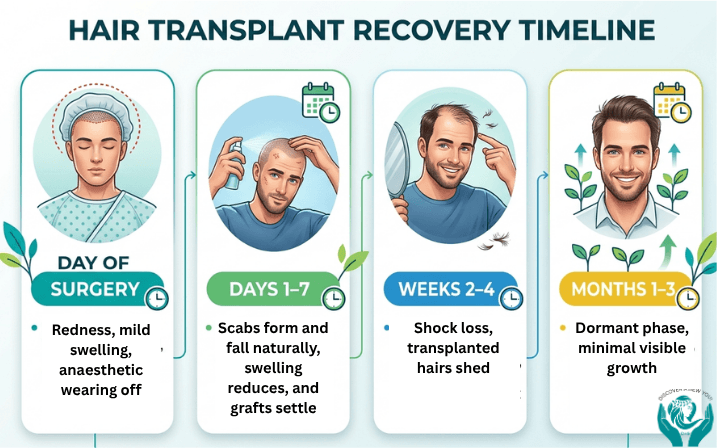
Hair transplant recovery is a journey that unfolds gradually over weeks and months. Understanding each phase of this journey is just as important as the procedure itself. Whether you have just had an FUE (Follicular Unit Extraction) or FUT (Follicular Unit Transplantation) hair transplant at Dr. Hijrat Aesthetic Clinic in Islamabad, or are planning to undergo the procedure. Most patients return to their normal routine within 7 to 10 days. Your final hair transplant results, however, reveal themselves gradually, with full density typically visible between 9 and 12 months after surgery. Always follow the personalized instructions provided by your surgeon. You will find everything you need to know right here, day by day, week by week, month by month.
Understanding Hair Transplant Recovery: Two Distinct Phases
Before diving into the week-by-week breakdown, it helps to understand that hair transplant recovery has two separate phases:
Phase 1: Initial Healing (Weeks 1–2):
Your scalp recovers from the procedure. Redness, scabbing, and mild swelling are all part of this stage.
Phase 2: Hair Growth Period (Months 1–12):
The transplanted follicles go dormant, then gradually produce new hair. This is where patience pays off.
Knowing which phase you are in helps you interpret what you see in the mirror, and stops unnecessary worry.
Hair Transplant Recovery Timeline: At a Glance
Use this quick reference table to understand the full hair transplant recovery timeline before we explore each phase in detail.
|
Phase / Timeframe |
What to Expect |
Key Aftercare Tips |
|---|---|---|
|
Day of Surgery |
Redness, mild swelling, anaesthetic wearing off |
Rest completely, avoid touching grafts |
|
Days 1–7 |
Scabs form and fall naturally, swelling reduces, and grafts settle |
Sleep elevated, gentle washing from day 3, no rubbing |
|
Weeks 2–4 |
Shock loss, transplanted hairs shed |
Stay patient, avoid exercise, and pools |
|
Months 1–3 |
Dormant phase, minimal visible growth |
Attend follow-up, keep scalp clean |
|
Months 4–6 |
Fine hairs emerge, density improving |
Avoid the sun, eat well, and stay hydrated |
|
Months 7–12 |
Hair thickens, final results visible |
Style freely, attend 12-month follow-up |
Note: Recovery experiences may vary. Always follow the specific instructions provided by your surgeon.
Let’s break this down in detail so you know exactly what to expect at each stage.
Day of Surgery: What Happens Right After
Your hair transplant procedure at Dr. Hijrat Clinic is performed under local anaesthesia, so you remain comfortable throughout. Once the session ends, your scalp will show visible redness and small pinpoint marks where the grafts were placed or extracted.
In the hours after surgery, you may notice:
-
Mild tightness or tenderness in both the donor and recipient areas
-
Some light oozing or pink-tinged discharge. This is completely normal
-
A slightly swollen forehead, which may develop over the next 24 to 48 hours
Your care team will provide a detailed aftercare kit along with written instructions before you leave. This typically includes a travel neck pillow, saline spray, antibiotics, a specialised shampoo, and emollient cream.
Important: Do not touch, rub, or press on the transplanted area on the day of surgery. The grafts are at their most vulnerable in the first 72 hours.
Days 1–7: The First Week of Recovery
The first seven days are the most delicate part of your hair transplant recovery. The transplanted follicles are anchored into their new location — protecting them is the priority.
What to Expect
-
Scabs form around each graft by day 2 or 3, then fall naturally
-
Redness and swelling in both donor and recipient areas
-
Forehead swelling peaks around day 2 to 3, then reduces
-
Mild discomfort or tightness is common, but most patients find it manageable.
-
Swelling reduces noticeably by day 5 to 7
Care After Hair Transplant — Days 1–7
-
Sleep with your head elevated at a 45-degree angle
-
Take prescribed antibiotics and anti-inflammatory medication
-
Begin gentle washing from day 3 using a sulfate-free shampoo
-
Pat dry only, never rub the scalp with a towel
-
Avoid alcohol, smoking, pools, saunas, and heavy sweating
Weeks 2–4: The Shedding Phase
This is the stage that surprises most patients and causes the most unnecessary panic. Between weeks 2 and 4, the transplanted hairs will begin to shed. This is called shock loss, and it is a normal part of the hair transplant recovery timeline.
What is shock loss?
Shock loss occurs because the transplanted hair follicles enter a resting phase (called the telogen phase) as a natural response to the surgical trauma. The hair shafts fall out, but this is the critical point the follicles themselves remain alive and intact beneath the scalp. These follicles will begin producing new, permanent hair in the months ahead.
Shock loss is not a sign of failed grafts. It is a biological process that almost every patient goes through. The follicles are resting, not dying.
What to expect during weeks 2–4
-
Most transplanted hairs shed during this window
-
The scalp may look similar to how it appeared before the procedure
-
Some patients experience mild itching as new follicle activity begins beneath the surface
-
The donor area continues to heal and may show small, fading marks
Care after hair transplant — Weeks 2–4
-
Resume light exercise such as walking, but avoid heavy exertion
-
Keep away from swimming pools and saunas for at least 4 weeks post-surgery
-
Continue gentle washing and scalp hygiene
-
Avoid harsh chemical products or heat styling tools
-
Attend your second post-operative check-up, either in person or virtually
Months 1–3: The Waiting Game (Dormant Phase)
After the shedding phase, your scalp enters a quiet period. Little is visible on the surface, but beneath it, the transplanted follicles are preparing for active growth. This is often the hardest phase psychologically understanding that dormancy is a necessary biological step makes it easier to stay patient.
What to Expect
-
Little to no visible growth on the recipient area
-
Scalp looks fully healed and settled
-
Donor area scarring (if FUT) continues to fade
-
No pain or discomfort at this stage
After Hair Transplant Care — Months 1–3
-
Continue prescribed hair care products such as minoxidil if recommended
-
Protect scalp from UV exposure use SPF or a hat outdoors
-
Maintain a protein-rich diet to support follicle health
-
Attend your 3-month follow-up at Dr. Hijrat Aesthetic Clinic.
Months 4–6: The First Signs of New Hair Growth
This is the phase patients have been waiting for. Around the third to fourth month, fine, soft hairs begin to emerge from the transplanted follicles. Early growth can appear thin and slightly patchy this is normal. Over the coming weeks, these hairs thicken and gain colour.
What to expect
-
Fine, thin hairs are visible in the recipient area from around month 3 to 4
-
Hair gradually thickens and density improves month by month
-
You may see approximately 20 to 40 percent of your final results by month 5 or 6
-
Styling becomes noticeably easier as coverage improves
-
Any shock loss of native hairs around the transplant site also begins to recover at this stage
After Hair Transplant Care — Months 4–6
-
You can return to your normal hair washing and styling routine
-
Light gym sessions are typically permitted; confirm with your surgeon
-
Consider PRP (Platelet-Rich Plasma) therapy to enhance and accelerate results ask Dr. Hijrat about the PRP Hairfall Treatment available at the clinic
-
Attend your 6-month follow-up. This is a meaningful midpoint assessment
Months 7–12: Full Hair Transplant Results Take Shape
The final stretch of your hair transplant recovery timeline brings the results you have been waiting for. Hair thickens, density builds progressively, and transplanted hair blends naturally with your existing hair. By month 12, most patients see their full hair transplant results.
What to Expect
-
Significant improvement in density and coverage
-
Transplanted and native hair blend seamlessly — no visible difference
-
Style your hair freely using regular products
-
The donor area fully healed with minimal scarring, especially with FUE
After Hair Transplant Care — Months 7–12
-
Attend your 12-month follow-up at Dr. Hijrat Aesthetic Clinic
-
Discuss any minor touch-ups needed for optimal density or symmetry
-
Continue minoxidil or finasteride if advised by your surgeon
-
Enjoy your new hairline with confidence
Complete Aftercare Guide: What to Do and What to Avoid
Following your surgeon's aftercare instructions is the single biggest factor in achieving great hair transplant results.
Do
-
Sleep with your head elevated for the first 7 days
-
Take prescribed antibiotics and medications as directed
-
Begin gentle washing from day 3 using a sulfate-free shampoo
-
Eat a protein-rich, balanced diet throughout recovery
-
Attend all scheduled follow-up appointments
Avoid
-
Touching, rubbing, or scratching the transplanted area in the first 2 weeks
-
Alcohol and smoking for at least 2 weeks
-
Strenuous exercise and heavy sweating for 4 weeks
-
Swimming pools, saunas, and hot tubs for 4 weeks
-
Picking at scabs lets them fall naturally
Conclusion:
Hair transplant recovery is not instant but it is predictable. Every phase, from the initial scabbing to shock loss to the quiet dormant months, is part of a natural biological process that ends with a permanent, natural-looking result.
Follow your aftercare instructions, attend your follow-up appointments, and give your body the time it needs. The patients who achieve the best hair transplant results are always the ones who stay patient, consistent, and well-informed. At Dr. Hijrat Aesthetic Clinic in Islamabad, Dr. Hijrat Ullah and his team are with you at every stage from your very first consultation to your 12-month follow-up.
Ready to start your hair restoration journey? Book your free consultation with Dr. Hijrat today and take the first step towards permanent, natural-looking results.
Frequently Asked Questions
-
How long does hair transplant recovery take?
Initial healing, meaning scabs falling and redness fading, takes 7 to 14 days. Full hair transplant results, however, develop over 9 to 12 months as the transplanted follicles complete their growth cycle.
-
Is shock loss after a hair transplant permanent?
No. Shock loss is a temporary phase where transplanted hair shafts shed in the first 2 to 4 weeks. The follicles remain intact and alive beneath the scalp and will produce new, permanent hair from around month 3 to 4 onwards.
-
When can I exercise after a hair transplant?
Light activities such as walking can resume after around 2 weeks. Strenuous exercise, heavy lifting, and activities causing excessive sweating should be avoided for at least 4 weeks. Always confirm with your surgeon before returning to the gym.
-
When will I see hair transplant results?
Early growth becomes visible around months 3 to 4. By month 6, most patients can see 40 to 50 percent of their final result. Full, mature hair transplant results are typically visible between 9 and 12 months after surgery.
-
Can I wear a hat after my hair transplant?
In the first few days, avoid anything that presses on the transplanted area. After week 1, a loose-fitting hat may be worn with clinic approval. Tight caps or hats with inner bands should be avoided in the first few weeks.