
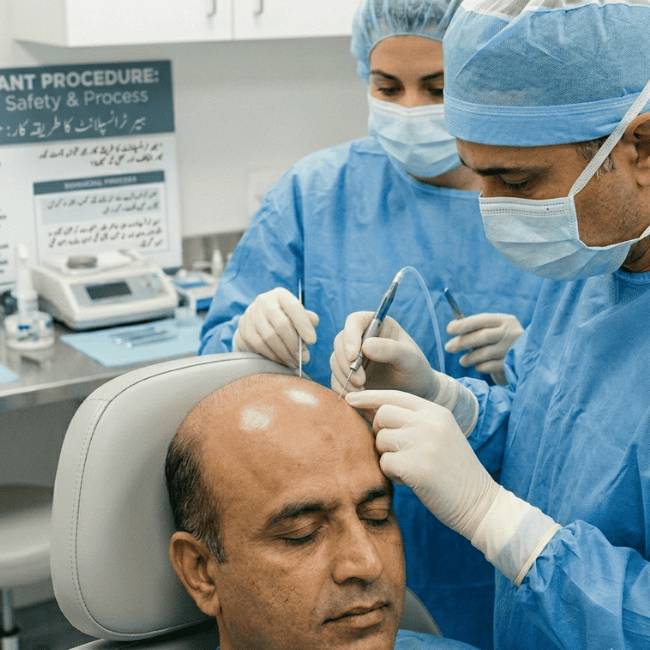
You have been losing hair for months, maybe years. You have tried oils, shampoos, and supplements, but nothing has worked. Now someone is recommending a hair transplant. It is completely natural to wonder if a hair transplant is safe. The honest answer is yes, especially when the procedure is performed correctly. Modern hair transplant procedures have a documented success rate of 95–98% when performed by experienced, board-certified surgeons. But like any surgical procedure, there are real risks you need to know about and, more importantly, how to avoid them.
In this guide, we walk you through 10 real risks of hair transplants and the exact steps to avoid each one so you can make a confident, informed decision.
What Is a Hair Transplant?
A hair transplant is a simple procedure where healthy hair is moved from the back of your head to the bald areas. It is done under local anesthesia, which means you stay awake and go home the same day. Because it uses your own natural hair, it is safe, looks real, and won't be rejected by your body.
10 Real Hair Transplant Risks And Exactly How to Avoid Each One
1: Infection at the Transplant Site
One of the most frequently asked questions is about hair transplant infection. The good news, according to research published in the Journal of Cutaneous and Aesthetic Surgery, infection rates after hair transplant surgery are less than 1%. The scalp has strong blood flow, which naturally fights bacteria. However, infection can still occur if post-operative care instructions are ignored, especially touching the scalp with unwashed hands or failing to follow the washing routine given by your surgeon.
How to Avoid It:
Choose a clinic that follows strict sterile protocols and uses single-use surgical tools. After the procedure, follow your surgeon's aftercare instructions exactly, wash your scalp gently as directed, avoid touching the grafts with your bare hands, and attend all follow-up appointments. If you notice redness spreading beyond the graft sites or yellow discharge after Day 5, contact your clinic immediately.
2: Temporary Hair Shedding After the Transplant
Many patients are alarmed when they see hair falling out 2–4 weeks after their procedure. This is called shock loss (or telogen effluvium), and it is completely normal. The hair follicles go temporarily dormant after being relocated. According to medical research, shock loss typically begins 2–6 weeks post-surgery, and the hair begins regrowing within 3–4 months, with full results visible by 12–18 months. It is not a sign that the transplant failed.
How to Avoid It:
Ask your surgeon about shock loss before the procedure so you are mentally prepared. Your doctor may recommend starting Minoxidil within 2 weeks of surgery to reduce shock loss and support faster regrowth. Understanding the full hair transplant result timeline will prevent unnecessary panic during recovery.
3: Poor Graft Survival Follicles That Do Not Take
Grafts are living tissue. If they are not harvested, stored, and implanted with precision, they can fail to survive in their new location. Factors that reduce graft survival include excessive handling, dehydration of follicles between extraction and implantation, overly dense packing, and poor blood supply in the recipient area. Smoking significantly worsens outcomes. A study in the Journal of Cutaneous and Aesthetic Surgery found that among patients who experienced necrosis after hair transplant, 66.7% were smokers.
How to Avoid It:
Stop smoking at least 2 weeks before and after surgery. Make sure your clinic uses proper graft storage solutions and minimises the time grafts spend outside the body. At a quality clinic, the surgical team works efficiently to ensure follicles are transplanted as quickly and carefully as possible.
4: Overharvesting the Donor Area
This is a risk that many clinics will not openly discuss, but it is one of the most serious long-term risks of hair transplant surgery. Overharvesting occurs when too many follicles are extracted from the donor zone, leaving behind visible thinning, a moth-eaten appearance, or permanent damage to the donor area. According to a 2025 meta-analysis published in Aesthetic Plastic Surgery, overharvesting is one of the primary technical errors associated with FUE procedures.
How to Avoid It:
Always consult with a board-certified surgeon, not just a technician who will carefully assess your donor density and design a conservative harvesting plan. A responsible surgeon will always protect your donor reserve for future sessions if needed. Be wary of any clinic promising an unusually high number of grafts in a single session.
5: Visible Marks at the Donor Site
Scarring is a reality of hair transplant surgery, but how noticeable it is depends entirely on the technique used and the surgeon's skill. FUT leaves a linear scar at the back of the scalp, which may be visible with very short haircuts. FUE leaves tiny dot-like marks that are usually invisible with normal hair length. According to the American Society of Plastic Surgeons, excessive tension during wound closure can lead to 'stretch-back' scars that are wider than expected.
How to Avoid It:
Discuss scarring honestly with your surgeon before the procedure. If you prefer very short hair, FUE or DHI is the better choice. Ensure your surgeon performs a layered wound closure for FUT to minimise scar width. Avoid strenuous physical activity for at least one week after surgery to prevent wound dehiscence.
6: Inflamed or Infected Hair Follicles
Folliculitis, inflammation of the hair follicles, is one of the most commonly reported post-operative complications. In a study of 2,896 hair transplant patients conducted over 10 years, sterile folliculitis was the most frequent complication, occurring in 203 patients. It appears as small, red, pimple-like bumps around the transplanted area and can be either sterile (non-infectious) or bacterial.
How to Avoid It:
Warm compression for 15 minutes, 2–3 times a day, is effective for mild sterile folliculitis. For bacterial folliculitis, your surgeon will prescribe topical or oral antibiotics. The key is not to scratch or pick at the affected area, as this can spread infection and damage grafts.
7: Unnatural-Looking Hairline
A cosmetically failed hair transplant, one where the hairline looks pluggy, unnatural, or mismatched to your face, is an aesthetic risk, not a medical one. But for many patients, it can be just as devastating. This happens when the graft angle is wrong, when large follicular units are used at the hairline, or when the hairline design does not account for your age, facial structure, or future hair loss pattern.
How to Avoid It:
Choose a surgeon who specialises specifically in hair restoration, not a general cosmetic surgeon who occasionally performs transplants. Ask to see actual before-and-after photos from your surgeon's own cases, not stock photos. A skilled surgeon always places single-hair follicular units in the first row of the hairline for the most natural result.
8: Hair Transplant Side Effects from Medical Conditions
Certain health conditions directly affect how safe your hair transplant will be. Uncontrolled diabetes slows wound healing and increases infection risk. High blood pressure increases the risk of bleeding during surgery. Blood-thinning medications, if not paused before surgery, can cause excessive bleeding. Autoimmune conditions like alopecia areata may cause unpredictable results. According to KEIT.al's (the largest and most advanced cosmetic surgery center in Europe) 2023–2025 systematic review of hair transplant complications, patient factors including smoking, diabetes, and vascular insufficiency significantly heighten complication risk.
How to Avoid It:
Always disclose your complete medical history to your surgeon. Blood sugar must be stable before, during, and after the procedure for diabetic patients. Blood pressure should be well-controlled. Your surgeon will advise you on which medications to pause before surgery. Never stop prescribed medications without medical guidance.
9: Swelling, Numbness, and Temporary Discomfort
Forehead swelling is common within the first 2–3 days after a hair transplant. In some cases, the swelling can extend to the eyelids, causing temporary bruising. Temporary numbness in the donor or recipient area can last anywhere from 3 to 18 weeks, depending on your individual healing. These are expected surgical consequences, not dangerous complications, but patients who are not prepared for them often panic unnecessarily.
How to Avoid It:
Sleep with your head elevated at 45 degrees for the first 3–5 days to minimise swelling. Follow your clinic's post-operative instructions carefully regarding activity restrictions, alcohol, and sun exposure. Your surgeon will prescribe appropriate medication to manage any discomfort.
10: Choosing the Wrong Clinic or Unqualified Surgeon
Choosing the Wrong Clinic or Unqualified Surgeon. Last but not least, this is the ultimate risk. A hair transplant is only as safe as the hands performing it. Low-cost, technician-run clinics often skip vital hygiene steps. While Medical News Today confirms the scalp's high blood flow helps, true safety only comes from professional surgical standards.
How to Avoid It:
Verify your surgeon's credentials and board certification. Ask specifically whether the surgeon will be present throughout the entire procedure. Review real patient results.
What the Medical Research Actually Says
Before making any decision, here are the facts backed by medical research:
- Stat 1: Infection rates after hair transplant surgery are less than 1% when proper sterilization and post-operative care are followed. (Source: Journal of Cutaneous and Aesthetic Surgery, 2018)
- Stat 2: A 10-year study of 2,896 hair transplant patients recorded zero life-threatening or major complications, with a minor complication rate of just 0.10%. (Source: Indian Journal of Plastic Surgery, 2021)
- Stat 3: Modern hair transplants have a 95–98% success rate when performed by experienced surgeons. (Source: DenceSpot Medical Review, 2025)
- Stat 4: A 2025 systematic review and meta-analysis in Aesthetic Plastic Surgery confirmed that hair transplant surgery is 'generally safe,' with pain, swelling, and edema being the most commonly reported and temporary complications.
Expert Opinion: What a Hair Restoration Surgeon Wants You to Know
The procedure itself is not what makes a hair transplant safe or risky; it is the surgeon's experience, the clinic's standards, and the patient's honesty about their health history. When all three come together, a hair transplant is one of the most predictable and rewarding procedures in cosmetic medicine. What I tell every patient who walks into our clinic: your safety is our priority, before any graft count or technique is ever discussed.
Dr. Hijrat, Hair Restoration Specialist | drhijratclinic.com
Real Patient Story: From Fear to Confidence
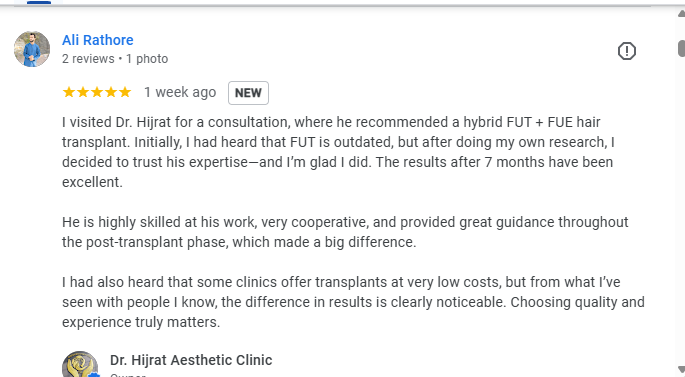
Ali Rathore visited Dr. Hijrat with doubts about FUT, fearing it was an outdated technique. However, after a detailed consultation and his own research, he decided to trust the doctor’s recommendation for a Hybrid FUT + FUE procedure.
The Transformation: Seven months later, the results have been excellent. Ali noted that the personalized guidance during the post-transplant phase made a significant difference in his journey.
"I’ve seen the results from low-cost clinics, and the difference is clearly noticeable. Choosing quality and experience truly matters. I’m glad I trusted Dr. Hijrat."
What a Successful Hair Transplant Result Actually Looks Like
A well-executed transplant looks so natural that even a barber won't notice. Here is the journey:
Days 1–10: Mild redness, scabbing around grafts, and minor swelling are all normal signs of healing
Weeks 2–6: Shock loss begins, and transplanted hair sheds. This is temporary and expected
Months 2–4: Dormant phase, little visible change, but follicles are establishing blood supply underground
Months 4–8: New hair begins emerging fine at first, then gradually thickens
Months 10–14: Full hair transplant result, visible natural density, natural hairline, natural growth direction.
Conclusion
A hair transplant is one of the safest and most effective cosmetic procedures today. While risks like shock loss or minor inflammation can occur, they are temporary and easily manageable. The real secret to a successful transformation lies in choosing an experienced surgeon and following proper aftercare. When you prioritize quality over low costs, you ensure results that are not only safe but look completely natural for a lifetime.
Hair restoration is more than just a medical procedure; it is about regaining your lost confidence. By making an informed decision today, you are choosing a future with a fuller, more youthful appearance.
Stop wondering and start knowing. Book your free consultation at Dr. Hijrat Clinic today for an honest, personalized assessment of your hair restoration options.
Frequently Asked Questions
1. Is it safe for diabetics?
Yes, provided blood sugar is well-controlled. Since diabetes can slow healing, we require clear blood work before proceeding to ensure a safe recovery.
2. Does it cause permanent scarring?
FUT leaves a thin line, while FUE leaves tiny dots. Both are permanent but remain hidden under your hair and are virtually invisible with proper surgical technique.
3. How long is the recovery?
Most patients return to work in 5–7 days. Initial scabs clear within 2 weeks, new growth begins at 3 months, and full results appear by 12 months.
4. How to find a safe clinic in Islamabad?
Choose clinics where a board-certified surgeon, not a technician, leads the procedure. Check genuine before-and-after photos and avoid clinics that pressure you into booking.
5. Are the results permanent?
Yes. Hair is moved from the permanent zone at the back of the head, so the transplanted hair will not fall out. However, you may still need care to protect your remaining original hair.