
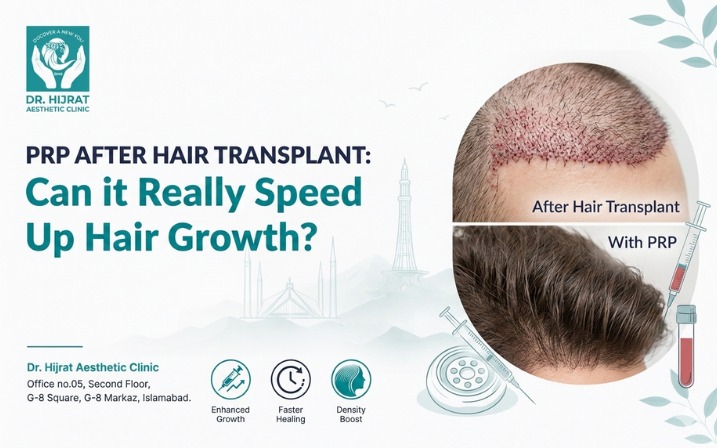
PRP After Hair Transplant: Can it Really Speed Up Hair Growth?
PRP after hair transplant is commonly used during the hair transplant recovery process to support healing and improve scalp recovery. The treatment involves using platelet-rich plasma from your own blood and injecting it into the scalp to support healing after surgery. Many people ask whether it can speed up hair growth or improve results after a hair transplant in Islamabad, but the outcome depends on individual healing response and post-transplant care.
What Is PRP and How Does It Work After Hair Transplant?
PRP stands for platelet-rich plasma. It is taken from a small sample of your blood and processed to collect growth-factor-rich plasma.
After a hair transplant, PRP is injected into the scalp in small amounts. The idea is to support healing and improve the environment around transplanted hair roots.
Understanding Platelet-Rich Plasma for Hair
Platelets contain natural growth factors. These help with tissue repair in the body.
In hair treatment, PRP is used to:
-
Support healing in the scalp
-
Improve blood flow in the treated area
-
Help strengthen hair roots
It is also used in PRP injections for hair loss, even without surgery.
Does PRP Really Speed Up Hair Growth After a Hair Transplant?
Many people believe PRP directly makes hair grow faster after surgery. In reality, PRP does not create new hair follicles on its own. Instead, it may support the existing healing and recovery process after a hair transplant.
Reducing Inflammation and Supporting Healing
Mild swelling, redness, and scalp sensitivity are common after surgery. PRP therapy may help reduce inflammation in some patients, which can make the recovery period feel more comfortable.
This may help:
-
Improve scalp comfort
-
Support early healing stages
-
Reduce temporary irritation after surgery
Improving Graft Survival in Early Stages
Transplanted grafts go through a sensitive recovery phase after implantation. During this period, proper blood supply and healing support are important for graft stability.
Some clinical studies suggest PRP may:
-
Support graft survival rate
-
Improve early follicle nourishment
-
Help transplanted grafts settle more effectively in the scalp
What Studies Suggest About PRP Results?
Research on PRP therapy after hair transplant has shown mixed but generally positive findings. Some studies suggest PRP may improve early hair density, healing speed, and overall graft support during recovery.
Clinical research published on platelet-rich plasma (PRP) hair restoration study and other medical journals has reported that PRP may support early follicle activity and improve recovery outcomes in some patients. However, results can vary depending on the individual healing response, treatment timing, and overall scalp condition.
Realistic Expectations vs Claims
PRP therapy should not be viewed as a guaranteed way to speed up hair growth dramatically. While some patients notice smoother recovery or earlier fine hair growth, others may see only limited differences.
PRP cannot:
-
Create new hair follicles
-
Replace a hair transplant procedure
-
Guarantee faster growth for every patient
It is mainly considered a supportive treatment that may improve the environment for healing and recovery after surgery.
When is the Best Time to Start PRP After Hair Transplant?
Timing is important for PRP after a hair transplant. It should not be done too early.
The Ideal Timeline for Scalp Recovery After Surgery
Most specialists suggest waiting until the scalp has started healing before starting PRP after a hair transplant. The healing process follows a predictable pattern, although it can vary slightly from person to person depending on the technique used and individual recovery speed.
General recovery timeline:
-
First few days: Healing begins right after surgery. Mild redness, swelling, and tightness in the scalp are common during this stage.
-
7–10 days: Small scabs start forming around the transplanted grafts and gradually begin to fall off with gentle washing.
-
10–14 days: Most scabs are naturally cleared, and the grafts become more stable in the scalp.
-
2–4 weeks: The scalp continues to settle, and a temporary shedding phase may start, which is a normal part of the hair cycle.
-
3–4 months: Early signs of new hair growth usually appear as follicles enter the active growth stage.
Clinical recovery guidance published on medical reference platforms, such as hair transplant recovery timeline and healing stages, explains a similar pattern where most initial healing takes around 10–14 days, while visible hair growth develops over several months.
How Many Sessions Do You Generally Need?
There is no fixed number for everyone. However, many patients may undergo:
-
2 to 4 sessions in the first few months
-
Follow-up sessions every few months if needed
This depends on the hair transplant recovery process and individual response.
The Added Benefits of PRP for Safe Hair Restoration
PRP is not only linked to growth. It also supports comfort and scalp health during recovery.
Reducing Redness, Swelling, and Crusts
After surgery, the scalp may feel tight or swollen. PRP may help:
-
Reduce mild swelling
-
Support faster skin recovery
-
Improve overall healing comfort
Strengthening Your Existing, Non-Transplanted Hair
PRP is not only for transplanted hair. It may also help existing hair.
It can:
-
Strengthen weak hair follicles
-
Slow down thinning in nearby areas
-
Improve the overall hair density appearance
Hair transplant services in Islamabad, including techniques like FUE and FUT, are commonly performed alongside supportive treatments such as PRP therapy. At clinics such as Dr. Hijrat Clinic, both surgical hair restoration and post-transplant care are typically evaluated based on individual hair loss patterns and recovery requirements.
PRP vs No PRP After Hair Transplant
People often compare recovery with and without PRP after a hair transplant. Both paths lead to hair growth, but the early healing experience and timeline can feel slightly different.
Differences in Recovery and Growth Timeline
|
Stage |
With PRP Support |
Without PRP |
|
Early healing (1–2 weeks) |
May show slightly reduced redness and irritation |
Normal healing process with mild swelling and scabbing |
|
Shock shedding phase (2–6 weeks) |
Shedding still occurs, but may feel less noticeable |
Standard shedding phase after transplant |
|
First visible growth (3–4 months) |
Some patients may notice earlier fine growth |
Typical growth starts in the same period |
|
Final results (9–12+ months) |
No major change in final outcome |
Same final timeline |
According to clinical guidance, initial hair growth after transplant usually begins around 3 to 4 months, with fuller results visible by 9 to 12 months, depending on healing and hair cycle progression.
Who May Benefit More From PRP
PRP may be more helpful for:
-
Patients with weak existing hair
-
People in the early thinning stages
-
Those looking for extra healing support
It may have less of a visible impact in patients with strong donor and recipient areas.
Limitations of PRP Therapy After Hair Transplant
PRP is helpful in some cases, but it has limits.
Not a Standalone Hair Restoration Solution
PRP cannot replace a hair transplant. It does not:
-
Move hair from one area to another
-
Fix advanced baldness alone
-
Guarantee permanent density increase
It is only a supportive treatment.
Factors That Affect Results
PRP results depend on:
-
Age and health condition
-
Stage of hair loss
-
Quality of transplant procedure
-
Number of sessions taken
Because of these factors, outcomes can vary.
Finding Quality Care for a Hair Transplant in Islamabad
In Islamabad, hair transplant procedures and PRP therapy are often offered together as part of recovery plans.
When considering treatment, people usually look at:
-
Experience of the medical team
-
Clear explanation of the procedure
-
Proper post-transplant care tips
-
Safe handling of PRP injections
Good results depend more on proper surgical technique and healing support than on any single add-on treatment.
FAQs
Does PRP help hair transplant results grow faster?
PRP may support healing and improve early recovery conditions, but it does not directly speed up hair growth for everyone. Results vary depending on individual response and transplant quality.
How soon can I safely get my first PRP session after a hair transplant?
Most patients start PRP after the scalp has healed, usually around 2 to 4 weeks after surgery. The exact timing depends on healing progress.
How many PRP sessions are needed after a hair transplant?
Many patients may need 2 to 4 sessions in the first few months. Some may require maintenance sessions depending on hair condition.
Is PRP painful after hair transplant surgery?
Discomfort is usually mild because numbing methods are used. Most people tolerate the procedure without major pain.
Can PRP stop the normal shedding phase that happens weeks after surgery?
PRP cannot fully stop shedding. Some patients may notice less visible shedding, but this phase is a normal part of the hair cycle.
Is PRP mandatory to get good results from a hair transplant?
No, PRP is not mandatory. Many patients achieve good results without it. It is only an optional supportive treatment.
Can PRP replace a hair transplant?
No, PRP cannot replace a hair transplant. It does not move or restore lost follicles in bald areas.
Final Thoughts on PRP After Hair Transplant
In Islamabad, PRP and hair transplant treatments are often considered together during the recovery process. Some people also read about the differences between both options to better understand how they work and what results they may expect, such as this comparison of PRP therapy and hair transplant procedures.
PRP after hair transplant may support healing, graft stability, and early recovery in some patients. However, it is not a guaranteed method to speed up hair growth or change the final outcome. It mainly works as a supportive option during the recovery phase.
Clinics such as Dr. Hijrat Clinic also offers hair transplant procedures along with PRP-based recovery support, depending on the patient’s needs, scalp condition, and overall treatment plan.